A GLOWING START FOR THE Takács QUARTET WITH THEIR NEW CELLIST
Takács Quartet: Music by Mendelssohn, Frank and Schubert, Vancouver Playhouse, September 22, 2026.
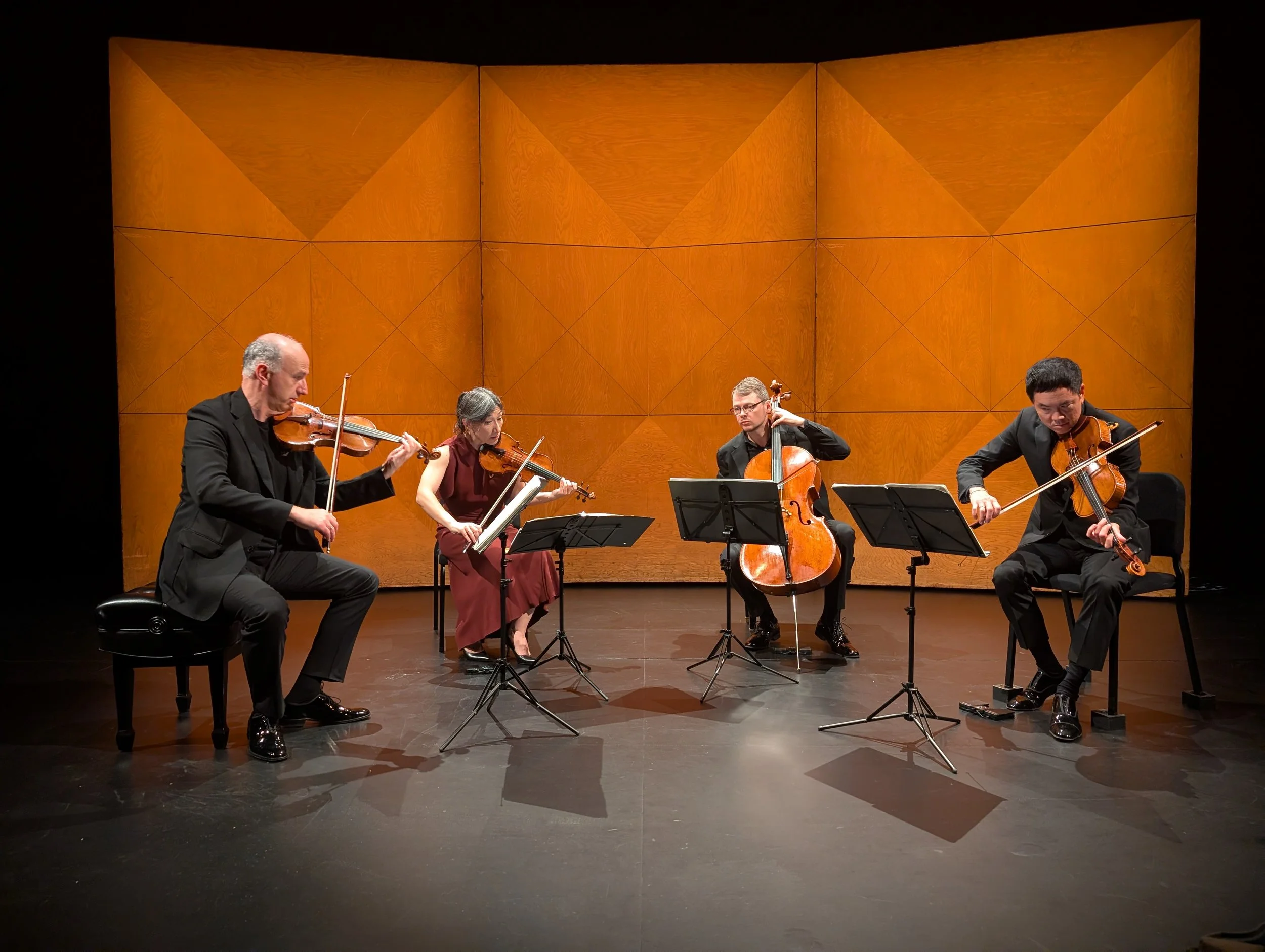
© Mark Mushet
Changes in personnel are one of the most perplexing challenges for any string quartet. And so it goes for the long celebrated Takács Quartet, founded in 1975. This concert introduced the excellent young Romanian cellist Mihai Marica, taking over the historic 51-year chair of founder András Fejér. As the third player change in a decade, it is inevitable that the ensemble's sound is in the process of adjustment, evolving from its leaner Hungarian roots into something more cosmopolitan and less sharply-etched and rustic. Yet the glowing interpretive strength remains: it would be difficult to think of more penetrating performances of Mendelssohn’s Quartet Op. 80 and Schubert’s ‘Death and the Maiden’ than we saw here. The addition of Gabriela Lena Frank’s intriguing modern work ‘Quijotadas’ showed that the ensemble is now expanding its contemporary reach.
The retirement of any member of a quartet is one thing, but the replacement of the original cello is a major event. András Fejér’s uncompromisingly direct and unvarnished expression in fact defined the group’s original DNA, now leaving only English violinist Edward Dusinberre –who replaced Gábor Takács-Nagy in 1993 – to transfer forward what is left of it. The situation was much the same with the Borodin Quartet, where cellist Valentin Berlinsky played for no less than 62 years to maintain the character of an ensemble which is now in its third iteration. The retirement of cellist David Finckel posed an immense hurdle for the Emerson Quartet, requiring years of work to get the group up to speed again.
On the current showing, the Takács Quartet succeeds in maintaining its individuality. In both the Mendelssohn and Schubert pieces, what was noteworthy is how the ensemble refused to cloak either work in generalized bleakness or anger (as is often the fashion these days) and sought a more subtle variety. When they performed this same Mendelssohn Quartet Op.80 here in 2017, I thought the relative restraint exhibited was marvellous. It allowed the lyrical aspects of the work to flourish alongside its thrust and sinew: after the imposing sforzandi and tempest at the opening of the work, we were able to relax into passages of redeeming beauty. But this time was different again: after the opening, we immediately settled into the scurrying string counterpoint that reminded one, yes, of the Overture to the composer’s Midsummer’s Night Dream, light and airy, yet anxious and shadowy too. As the movement progressed, the lyricism now seemed completely integrated rather than separated from the work’s momentum; the scenery just moved by as if one was on a train, building with strong insistence to the movement’s close.
I found smaller differences elsewhere. There was a feeling of strong determination in the Scherzo but I actually thought its ‘perpetual motion’ structure could be made airier too. The Adagio was again the highlight, starting from tender, innocent fragrances reminiscent of the composer’s earliest quartets, building to a greater weight in the middle before retreating to the type of radiant sweetness that only Mendelssohn could know. Here the perception of the composer’s style was extraordinary, though I found the middle climax somewhat less pronounced this time, and string accents less in evidence. Perhaps the sensitivity and warmth of the viola and cellist gave a smoother feeling, but the beauty of Mihai Marica’s playing was undeniable. The finale had keen pacing and inevitability, and was perhaps even more integrated than previously. I was impressed with the amount of freedom and joy the ensemble found, and the splendid shape and electricity they brought to the work’s close.
As I remarked last time, ‘Mendelssohn’s last quartet is revealed as a great work not only because it expresses a unique passion springing from personal loss (Fanny Mendelssohn’s death), but also because it synthesizes many of the special feelings and nuances that crystallize the composer’s art as a whole.’ I should also remark that Edward Dusinberre’s violin was dazzling throughout this piece, wonderfully clean and indeed virtuosic in a way that I don’t recall.
The Schubert ‘Death and the Maiden’ quartet was again less emotionally volatile than many recent interpretations. In fact, in the first movement, the Takács Quartet entertained a symphonic architecture akin to the final G major Quartet D.887. Led by Dusinberre, the ensemble was encouraged to push out the amplitude of the string phrases, letting the music breathe and expand into vast structural blocks of tension and release. The underlying despair was never made fully explicit: it was only subtly hinted at, peeking through a texture that at many points felt surprisingly buoyant and uncomplicated. Dusinberre treated some of the expansive lyrical lines with a frolicsome innocence and whimsicality of Schubert’s ‘Trout’ Quintet. The wonderful Webern-like passage at the end allowed the greatest contrast and revealed the disquieting mystery.
The Theme and Variations began with a wonderfully quiet, intimate statement of the opening theme, delivered with little vibrato and a suspending simplicity. From this hushed baseline, the continuity and sensitivity achieved in the subsequent variations was remarkable: the ensemble maintained a vast, organic trajectory which flowed like a river. It was this continuity that made the arrival of Variation 5 so effective; the long, expansive lines that had flowed so gracefully were suddenly caught in the undertow of a distant, approaching village procession. The tension and spatial perspective conveyed here were a highlight of the performance. As the funeral tread advances, the group sustains an unbroken crescendo that brings the procession relentlessly into the foreground. The climax arrives as a single, towering, and unavoidable wall of torment. This was beautifully achieved.
The Scherzo highlighted the ensemble's fine structural command, and allowed a sensitive lyricism in the Trio, but it was the finale – the ‘dance of death’ – that was the more intriguing. It was taken at quite a moderate tempo, but was full of fantasy, filled with a nervous skittishness, and sometimes an almost manic giddiness. The loud/soft alternations were masterly in making the shifts feel like unpredictable psychological lurching. A compelling dialogue emerged between the outer voices: the cello admirably provided a tight-knit anchoring drive to play off the more mercurial quality of Dusinberre’s violin line. The deliberate pacing transformed the movement: the group traded cutting-edge speed for collective strength, delivering a finale that felt simultaneously unstable and fully inevitable. This was very thoughtful performance.
Gabriela Lena Frank is a Grammy-winning Peruvian/American composer and pianist, and her Quijotadas (2007) provided a refreshing modern contrast between these two major pieces, offering a colourful and substantial piece of music. Based on Cervantes’ Don Quixote, the opening movements explored Spanish ancestral allusions with a pictorial sharpness – full of vivid, snapping pizzicato and clever modernist textures – but it was in the final movements where the depth emerged, conjuring a haunting sense of Spanish mystery and vulnerability. Delicate echo effects were affecting in their quiet, atmospheric intimacy, yet there was a crazed passion as well, especially notable in the driving, relentlessly rhythmic finale, ‘La Danza de los Arrieros’. It was perhaps an unintended homage to András Fejér that this movement immediately recalled the rustic, syncopated energy of Bartók’s Concerto for Orchestra. The ensemble showed full command over the challenges of the work.
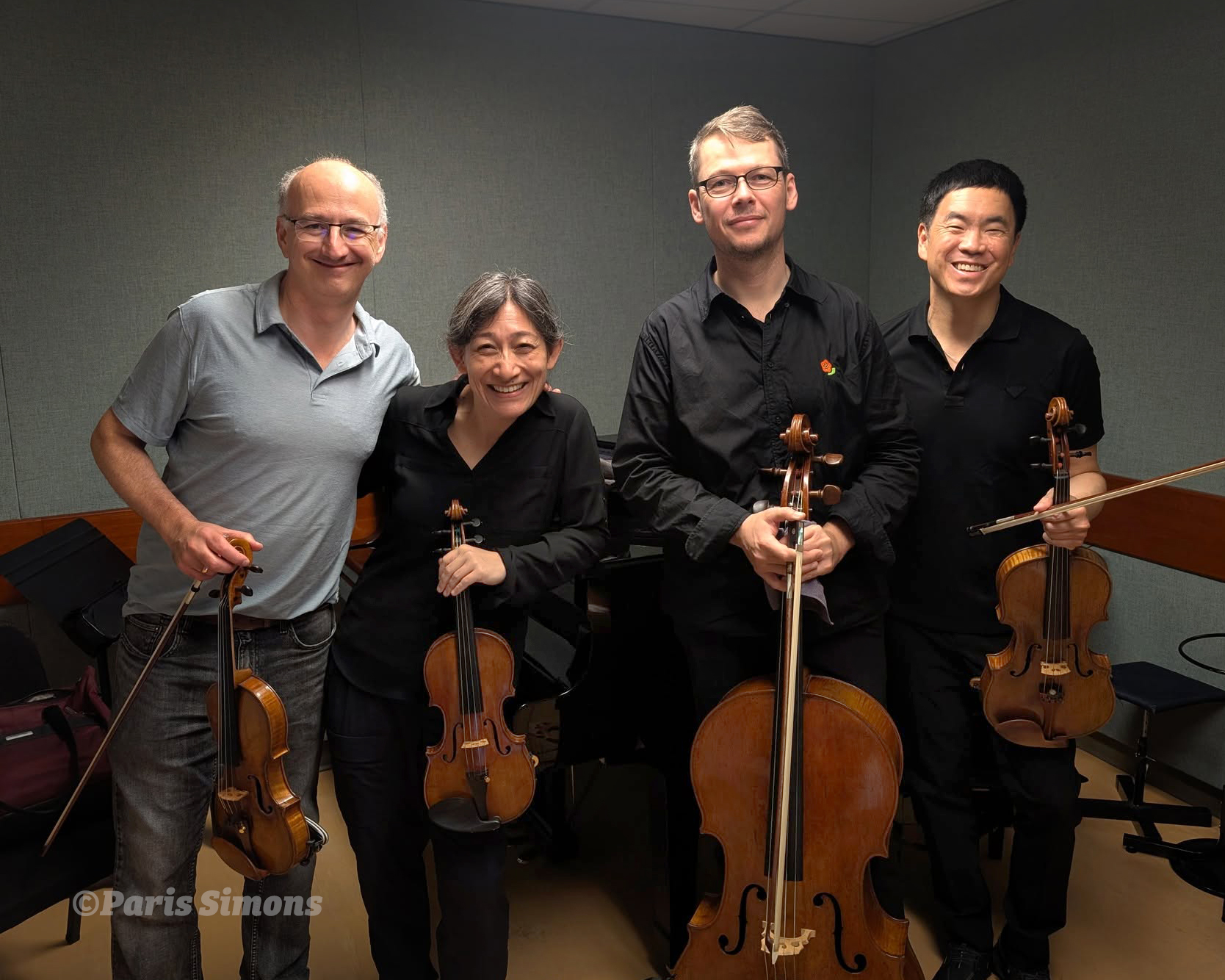
I think the incorporation of young Romanian cellist Mihai Marica is a genuine success; he has a fine sense of musical line, is exact in articulation, and shows genuine sensitivity at many points. However, he is doubtlessly a product of a modern conservatory training that stresses tonal beauty and refinement, and it may be a while until he masters Fejér’s characteristic directness and ‘growl’. As it stands, the ensemble’s sound now seems more homogeneous and more integrated than it was before. While the overall projection is warmer, the downside is that the individual instrumental voicings and timbres are perhaps not as transparent and differentiated. For these particular works, it seemed that the voicings of the lower strings stood out less than those of the two violins. Sforzandi were always a key to the ensemble’s attack in the past and, while I actually thought they might sometimes be too hard and cutting-edge, now they are padded by the richer bottom and may be actually too soft to get the fullest dramatic impact.
Of course, none of this takes away from the lovely experience this concert was. It takes a while for any ensemble to fully redefine itself with new players, and the quality level of the ensemble remains exceptional.
© Geoffrey Newman 2026