JOSHUA WEILERSTEIN GIVES A POWERFUL AND PROBING SHOSTAKOVICH 11
Zlata Chochieva (piano), Vancouver Symphony Orchestra/ Joshua Weilerstein (conductor): Works by Moussa, Mozart and Shostakovich, Orpheum Theatre, November 30, 2025.

This was a redeeming programme: a colourful and richly contoured work by Montreal-born Samy Moussa joined hands with Zlata Chochieva’s Mozart Piano Concerto No. 20, capped off by Josh Weilerstein’s powerful and committed reading of Shostakovich’s Symphony No.11. Chochieva’s major triumphs have been in Chopin and Rachmaninoff, but we saw clean and alert Mozart playing here, and she brought the concerto home with concentration and joy after a somewhat variable beginning. Weilerstein’s characteristic quest to find orchestral works that are less frequently played gave us an excellent performance of the Shostakovich that artfully balanced its cinematics with both structural awareness and underlying feeling.
Samy Moussa, now 41 and living in Berlin, has been very successful in getting his recent works performed internationally. He has an estimable ability to create pieces which have aura and suspension with the simplest of means, almost completely avoiding ‘modernist’ technical trappings. In Adgilis Deda: Hymn for orchestra, the resources were very Wagnerian both in spirit and in orchestral scoring. After a dark bassoon, wind punctuations over a lighter texture gave rise to a festival of Wagnerian moods. What was interesting was that tonal synergies and beauty of Tristan und Isolde, the nobility of the brass in Götterdämmerung, the repeated string figurations in the Tannhäuser Overture all seemed to register and sustain their spirit but the music itself was still very much Moussa’s own. He seems to find allusions that have an instant spell, and develops them with his own meaning and compelling flow. Whether I find this piece verging on film music doesn’t really matter, the art of putting this piece together with individuality and a strong emotional reach is noteworthy, and I found it a most uplifting way to begin a concert.
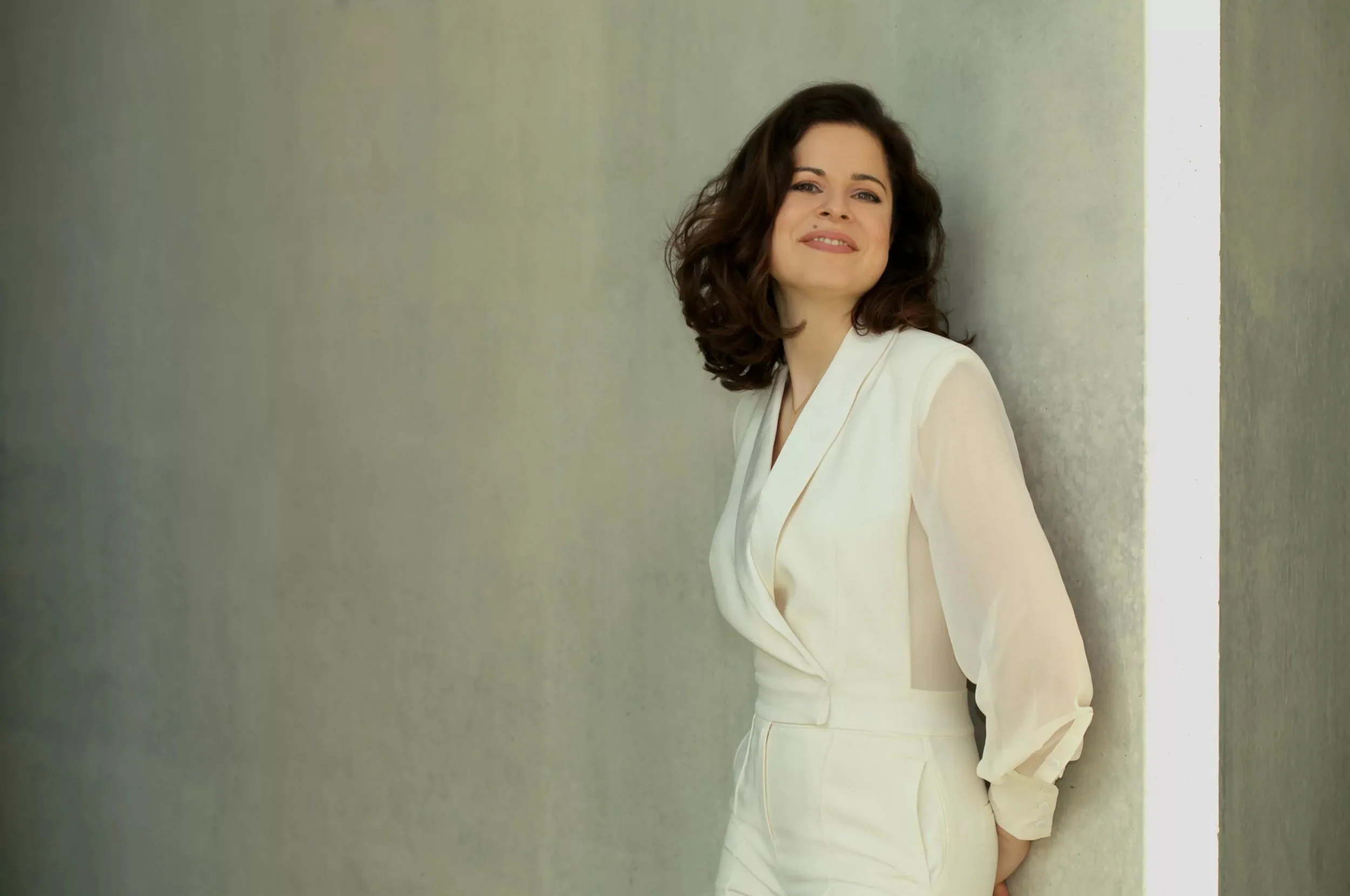
Russian Zlata Chochieva is a magnificent performer of romantic works, but I felt some degree of reserve in this performance of Mozart’s famous Piano Concerto No. 20. Her reading was beautifully articulated, but seemed reluctant to probe its darker undercurrent, and it took until the finale for her to really gain full spontaneity and emotional conviction. The first movement Allegro turned out surprisingly matter of fact. While the strong left-hand sequences were always firmly played, Chochieva missed their implied thrust and anxiety. In fact, it was serenity and beauty that perhaps stood out more than an underlying turbulence. That is, until we arrived at the ‘modernist’ cadenza (either Busoni or Pletnev-derived) where the familiar Zlata came back, finding great power and romantic feeling. This was most distinguished playing.
The slow movement had fine composure, but the pianist’s tendency to give a Schumannesque shaping and rubato to the opening motive undercut its purity, and some of the exposition ended up jaunty rather than inexorable. It was only in the finale that the directness and depth of expression surfaced – exhibiting cunning line and contrast, and compelling concentration of feeling. This was splendid, bringing the work home with an unusual sense of radiant joy. Josh Weilerstein’s conducting was very fine throughout, decisive and alert while working with a scale more in the direction of authentic performance.
After Shostakovich’s magnificent 10th Symphony, Nos.11 and 12 were widely admitted to be letdowns, substituting cinematics and Russian pageantry for genuine depth of feeling. There were few recordings of either in the early days, Leopold Stokowski’s reading of 11 perhaps being the most notable. While not much can be done with the 12th, the 11th (‘The Year 1905’) has gained much more traction when viewed through the lens that it was really another study in the agony and torment of tyranny – that the composer was really mocking, rather than endorsing, its celebratory character. This general viewpoint started just after the composer’s death in 1975 with the reinterpretation of the finale of the 5th Symphony as only ‘hollow’ celebration.

The work certainly has the ingredients to satisfy this viewpoint: a haunting, desolate opening contrasted by a slicing violence in the following movement which ends abruptly in silence, followed by a most tender and forgiving viola line at the opening of the third movement. The capstone is the finale which must set the dark memories of the previous movements against celebratory fanfare, creating a persistent ambivalence. The movement’s abrupt ending matches that of the second movement, leaving only a lonely bell to convey the emptiness of it all.
I thought Weilerstein did a superb job at putting all this together as an integrated and moving testament. The enigmatic and shifting chords of the quiet opening conveyed the right type of mystery and disembodiment, with only infrequent slips in tension, and the orchestra’s discipline in the scherzo was absolutely first rate. Moreover, the conductor was at pains to show the contrapuntal elements that underlay its cinematic violence, giving it musical substance. The subsequent viola theme was presented most sensitively: human and even hopeful. And the finale did carry the ambivalence forward, giving the big celebratory theme a feeling that it might actually be out of place in the hectoring drive and brutal larger-than-life projection elsewhere in the movement. The abrupt close of the work immediately took us back to the threatening silence at the end of the second movement (as it should), and left us with a deep and moving sense of tragedy. The result was fully laudable, and I can’t say enough about the orchestra’s execution throughout.
© Geoffrey Newman 2025