PUNCHY ADAMS AND A MORE RESERVED NIELSEN MARK DAVID ROBERTSON’S FAMILY FESTIVAL
Orli Shaham (piano), Vancouver Symphony Orchestra/ David Robertson (conductor): Works by Robertson, Adams and Nielsen, Orpheum Theatre, January 31, 2026.
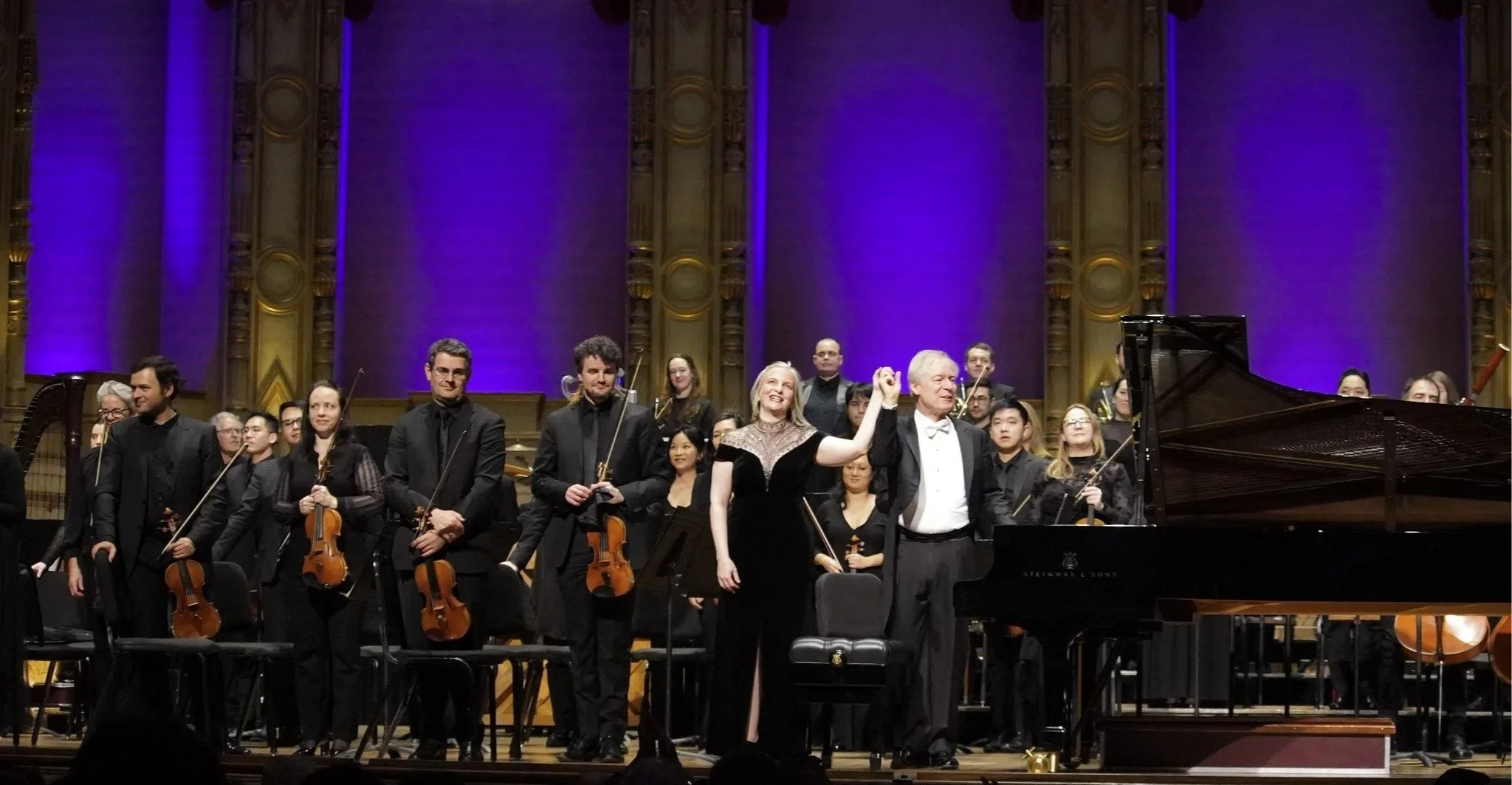
All photos courtesy of Vancouver Symphony Orchestra
This concert was a true family affair, featuring American conductor David Robertson. His 19- year-old son Alex premiered his own composition ‘Modum’, his wife Orli Shaham gave a riveting show of pianistic strength in John Adams’ Must the Devil Have All the Good Tunes? while the conductor himself took on Nielsen’s far-reaching Symphony No.4 ‘The Inextinguishable’. Indeed, this was an enticing mix of pieces with great potential for visceral engagement. However, while entertaining, the concert did not quite add up. While ‘Modum’ succeeds as a promising student work, the Adams piece, for all its ‘in your face’ pianistic bravura and catchy raw populism, may have drawn immediate impact but not a lasting imprint. And, ironically enough, while the much greater Nielsen symphony was given a finely appointed and integrated account, it did not find the work’s full emotional amplitude and ‘life force’.
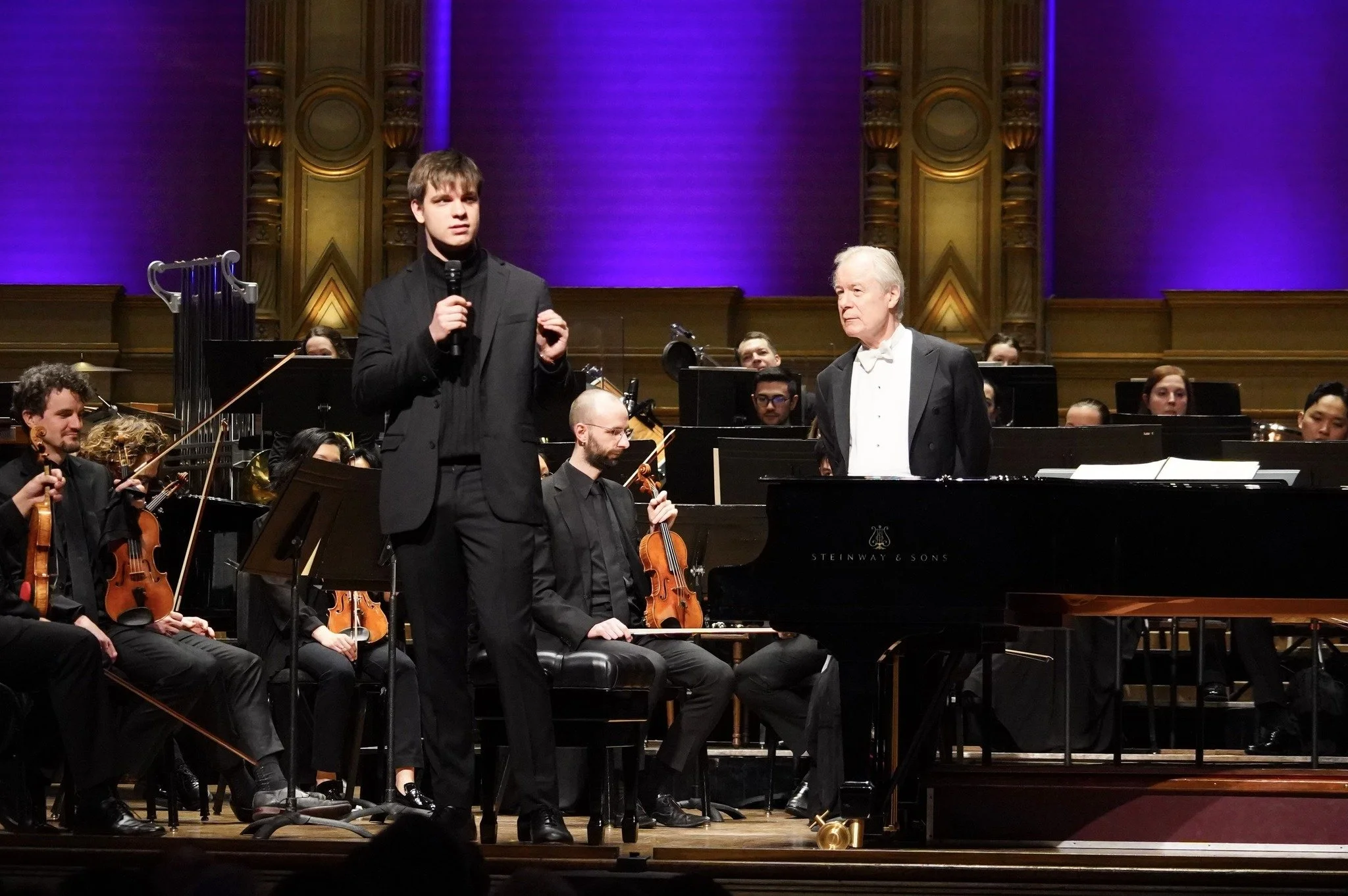
‘Modum’ is a short piece in the modernist tradition, and displayed remarkable assurance and mastery of craft for a 19-year-old Juilliard student. It has nicely varied textures and dynamics, strong layering and density, and is notable for its antiphonal voicings. From his father’s legacy, one can see the influence of Pierre Boulez, while his use of strong punctuations to mark structure seem to be in the tradition of his mentor Jörg Widmann. As the middle movement of 3 Figures for Orchestra, set between the ‘Appassionata’ opening and the ‘Eclogue’ finale, the piece was a little difficult to assess on its own, but it certainly stands as a worthy construction. Perhaps the most ‘family’ part of this premiere was Alex arriving on stage excitedly at the close and embracing his father.
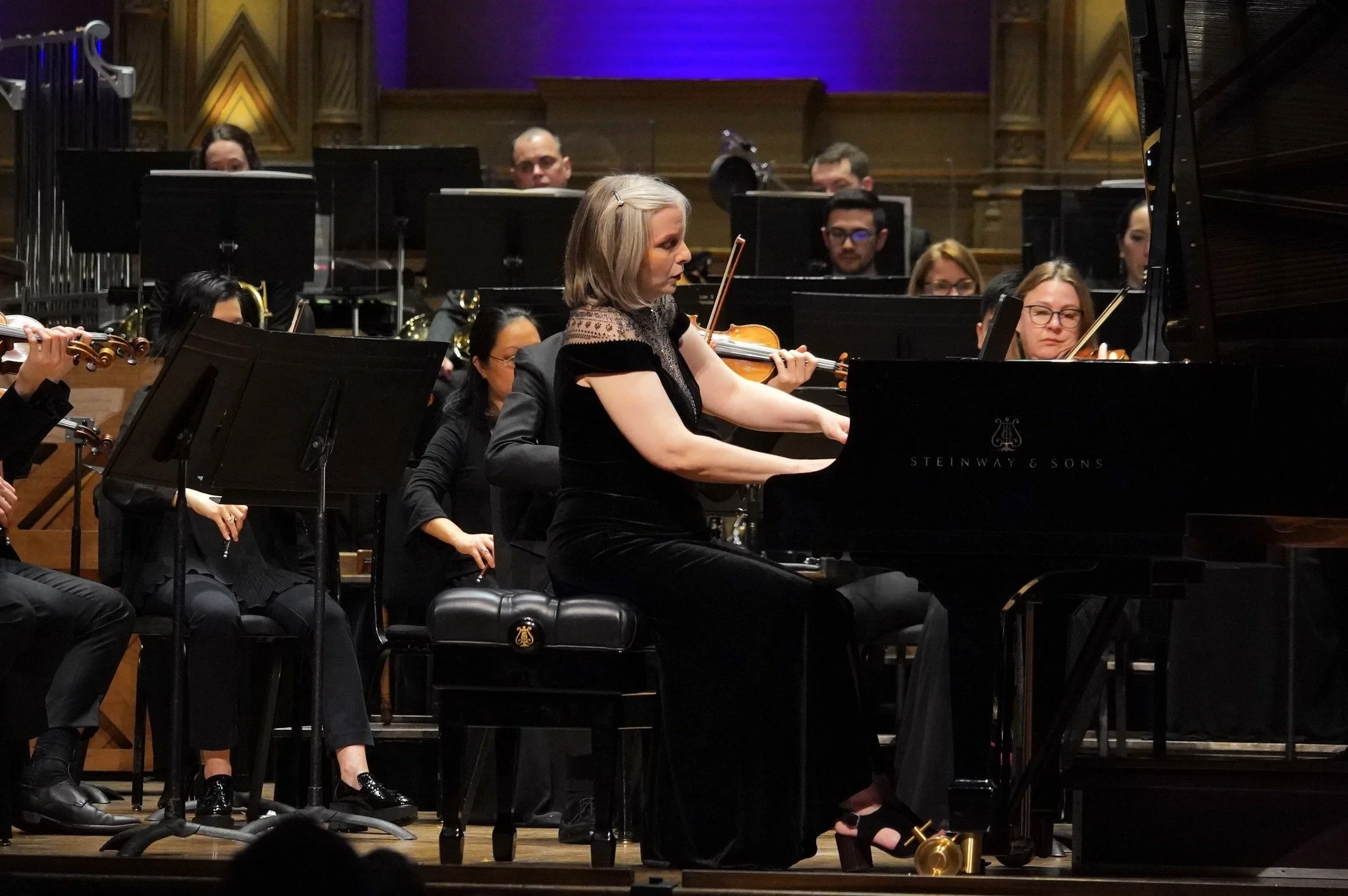
Next up was Orli Shaham in John Adams’ Must the Devil Have All the Good Tunes? – a work written for the formidable Yuja Wang, and premiered with Gustavo Dudamel and the LA Philharmonic in 2019. The work is essentially a juggernaut showpiece with a ‘noir’ slant, and Shaham’s pianistic command was stellar in the opening Peter Gunn theme and in the subsequent motifs and riffs based on 60s funk, rock and gospel. Her stamina had to be superb as her part does not stop; the piano is continuously projective, driving and loud, except for a few wind-downs. The middle movement finds a quieter countenance, and here we get nicely spun, airy textures which are intendedly off-key, slippery and possibly seductive. The finale resumes the propulsion and unremitting dynamics of the first, and depicts an American ‘Totentanz’, where the devil really comes in with all sorts of swinging, off-centre rhythms and other loopy and menacing tricks. The work definitely packs a wallop – and Shaham brought everything off with great elan. This was a very powerful, monolithic performance of the piece, possibly with less delicacy and shading than Yuja Wang.
There is no doubt that Adams has given us a fully accessible ‘impact’ piece. However, I do have sneaking doubts about how many times one would want to return to it, since each of the movements of the composition is rather unvaried in form, nor does it really recreate the ‘mood’ of the gritty industrial trappings of the 60s except playfully. Though augmented by an electric bass guitar and other period instruments, a basic concern is that the orchestral part of the work seems mainly like ‘padding’ for the piano. Thus, while piece does have many orchestral accents and rhythmic imitations, it does not have the consistent give-and-take of a concerto nor, given its ‘down-and-dirty’ demeanour, does it allow the orchestra to assault the ‘loud’ soloist with some of its own medicine, which would force a much more complex piano dynamics in the opening and closing movements. (Think of Bartok’s Piano Concerto No. 1.) In some ways, the work remains relatively static for all its energy and apparent motion. The music attempts to recreate the mood of a rough-and-tumble period where the Rustbelt was still thriving, but the orchestra seems to offer only a decorative frame around a generic picture.
A fair number of us first learned about Nielsen’s symphonies through Robert Simpson’s esteemed book Carl Nielsen: Symphonist (1952) and the authentic early recordings by Thomas Jensen, Launy Grøndahl and Eric Tuxen. These prompted a strong following in the UK and, eventually, abroad. Symphonies 4 and 5 are the composer’s big ‘wartime’ symphonies, and reveal the phenomenal range of his instrumental imagination, his ‘progressive tonality’, and the compelling force of his expression and humanity. The music is uncompromising and muscular, full of urgency and conflicts of sound and structure, but immediately communicative.
Daniel Raiskin in fact gave us a fine performance of Nielsen’s Second Symphony in February 2025 which had many of these attributes: a bluff strength coupled with strong architecture and involvement. Given David Robertson’s lifetime of advocacy of both modernism and minimalism, and interests in clarity and structural balance, one might expect something different in his treatment of the Fourth Symphony. Indeed, the result was a very clean, balanced, and polished account, but not very large in scale or as heaven-storming as one might wish. Many of the finest performances of this symphony have a visceral grip and intensity that never let go; this reading was softer and more considered and I did not think that was always for the better.
Symphony No. 4 was written in the middle of the World War I, and is in four continuously played movements. It is indisputably one of the greatest symphonies of the 20th century. Robertson’s first movement was structurally aware and, after a slight lack of fluency in getting the strings to their first crescendo, things settled down with the appearance of the wind sequences. There was more a feeling of athleticism than frenetic urgency as we moved forward but the climaxes were nicely set and tapered, the biggest of them having an imposing weight. I think of this movement as being more tumultuous and jagged than this treatment, driven by the sheer force of mankind’s ‘inextinguishable’ spirit, but this was appealing enough. Similarly, the wind band in the following Poco Allegretto played very well – but this is not simply an interlude of rustic charm. The winds actually weave in a subtle motion that makes their ultimate destination unknown, which fits with the dark uncertainty in the work.
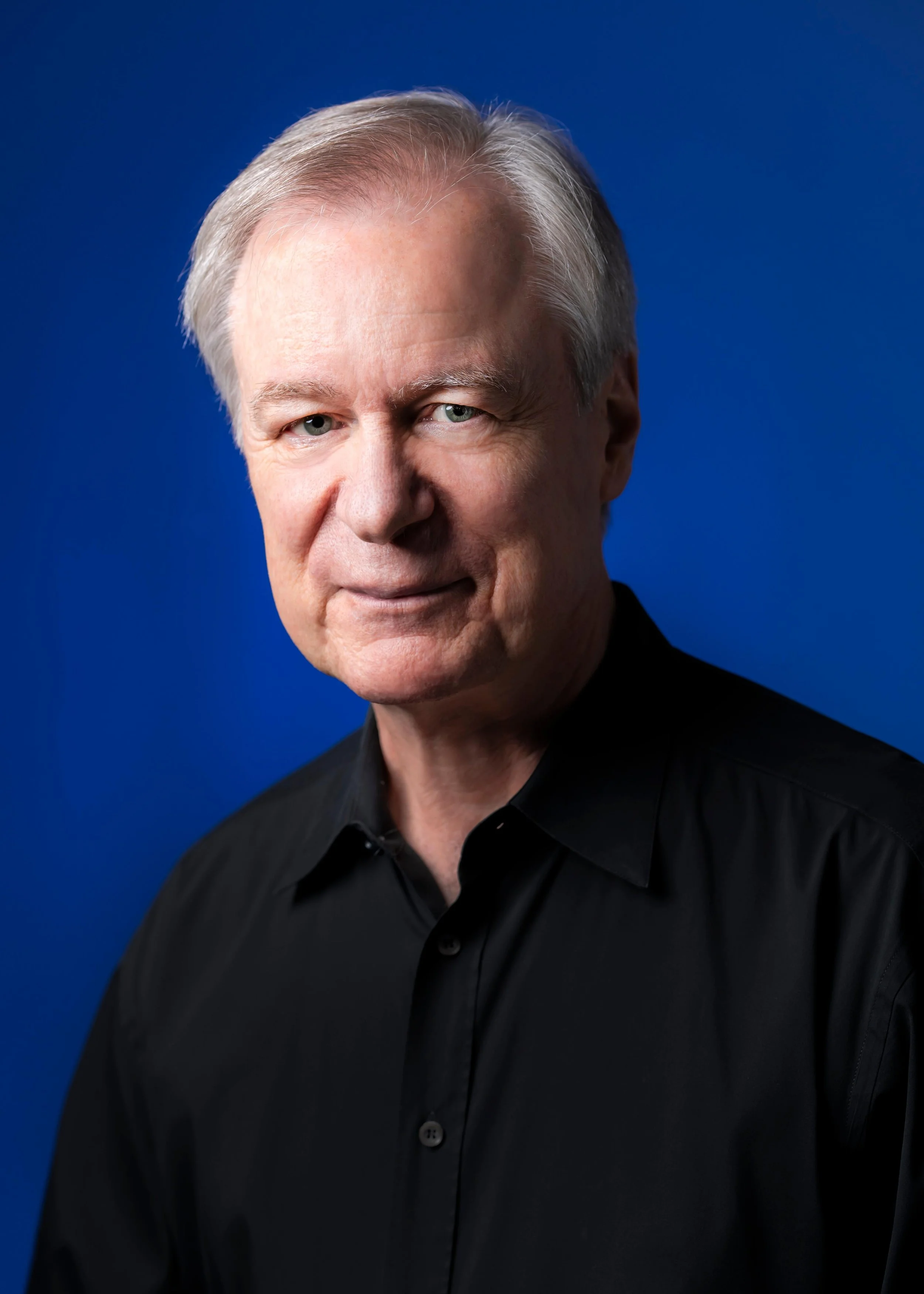
It was in the Poco Adagio that I had more serious concerns, since it is one of the composer’s most tragic statements. The searing strings of the opening were slightly underpowered and the bounce of the bass pizzicato could have been more emphatic, but the conductor proceeded in the right direction. The problem came when the soloists entered with their emotional three-note descending phrase: here the expression was inappropriately romanticized and softened in a Schumannesque way. Then, we proceeded to the important pizzicato passage, which must be stated firmly by top and bottom strings, and is present to convey a degree of bewilderment and imbalance. Here Robertson reduced volumes to near inaudibility, and spun these out with gossamer beauty in the spirit of Mendelssohn. I simply cannot see either of these interpretations fitting with Nielsen’s intent or, for that matter, the welling up of the of the human spirit that enshrines the climax at the end of the movement.
The finale – with its innovative double timpani – was nicely drawn and taken at a good tempo, but it seemed the timpani’s entrances were treated inconsistently. The timpani pair must fully threaten the orchestra since they are they are the force beating down mankind’s spirit. Interestingly, they frequently play tritones, a dissonant interval often referred to as ‘the devil in music’, so they might have deputized in the Adams piece as well! Their first entrance was strong and spectacular but subsequent occurrences seemed increasingly damped, as if they were now incorporated into the orchestral texture. But the timpani do not embody only a dramatic effect: they are structurally important and must remain aggressive combatants till the end. That is why I felt some concern over the very final pages where the orchestra hushes in coiled tension before the final crescendo and mankind’s inextinguishable spirit pushes out to triumph. The timpani must still be insistent here, and cannot become ceremonial. In this interpretation, it sounded like the resolution had already been completed, and the piece ended akin to Mahler’s Third Symphony. My overall feeling is the Robertson attempted to make this work more of a conventional romantic piece, underplaying its pathbreaking novelty.
In any event, a concert that offered a delectable range of musical styles and, indeed, plenty to think about.
© Geoffrey Newman 2026